
Where is the market headed?
The latest mutual fund inflow data for September reveals that Indian investors poured 38,000 crores into the mutual fund industry during the month. This substantial inflow positions September as one of the top three or four highest months for capital addition over the past year and a half, with only one or two months exceeding this level since July of last year. This surge in participation has occurred despite the broader equity market providing modest returns to investors.

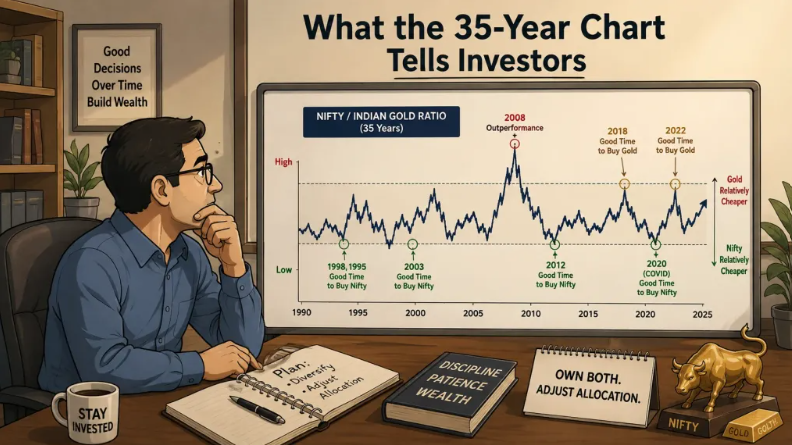
The continued commitment highlights that the majority of retail investors remain on an upward trajectory. With expanded access to market information, historical data, and educational case studies, investors are increasingly recognizing that short-term speculation is inefficient and that long-term disciplined investing offers the clearest path to success.
For investors who hold a steadfast belief in the long-term growth narrative of the Indian market, extended investment horizons remain highly viable. However, achieving successful outcomes requires choosing funds and investment vehicles that are inherently auto-correcting rather than clinging to past blue-chip performers. Relying solely on yesterday’s market leaders as primary bets for future growth can prove ineffective.
Instead, investment strategies that remain nimble and adapt to emerging areas of market strength are far more likely to be rewarded, offering a constructive perspective during periods of broader market stagnation.
Market Overview
Domestic market indices opened with a strong initial upward move that ultimately failed to sustain itself. After reaching an intra-day high of 22,600, the market pulled back by the close to settle at 22,360, leaving the Nifty down by 0.7 percent.

Major Market indices
In contrast, small-cap stocks demonstrated resilience with a gain of 1.13 percent, while the Nifty Next 50 and mid-cap indices managed to close without recorded losses. Bank Nifty experienced a decline of 0.61 percent. The bulk of the downward pressure across the market was concentrated within large-cap equities, particularly the Nifty 50 components and major banking institutions.
Foreign Institutional Investors (FIIs) maintained their persistent selling pattern, whereas domestic institutional and retail investors continued to allocate capital toward mid-cap and small-cap stocks. While ongoing domestic accumulation could eventually evolve into a circular trading scenario—where rising valuations in smaller capitalization stocks continuously draw in fresh funds—the current market environment has not reached that point.

Heat Maps
Major contributors to the downside on the Nifty heat map included State Bank of India, ITC, Hindustan Unilever, Bharti Airtel, Larsen & Toubro, Coal India, TCS, Reliance Industries, and ICICI Bank. On the positive side, minor gains were seen in Dr. Reddy’s Laboratories, Bajaj Auto, Bharat Electronics Limited (BEL), and Tata Motors.
Within the broader Nifty 500 segment, NIACL surged by 15 percent, Netweb gained 6 percent, whereas Lenskart experienced a sharp decline of 4 percent accompanied by high trading volumes. Other small-cap names featuring prominently in top turnover included IFCI, Tata Chemicals, Suzlon, MCX, Prime Focus, and Welspun Corp, while DMart and Apollo Hospitals continued to record losses.


Advance/Decline Trend
Market breadth also remained relatively favorable despite the pullback from morning highs, recording 269 advancing stocks against 227 declining stocks.

Sectoral Overview
Overall, the current environment reflects a stock-specific market where overarching indices remain range-bound while selective individual names maintain positive momentum.
Sectoral trends were mixed, led by a 4.6 percent surge in the Nifty Media index. Historically, strong single-day rallies in media stocks frequently coincide with sluggishness across the broader market, a pattern that repeated during this session.
Gains within the media space were driven by strong performances in Prime Focus, Tips Industries, Nazara Technologies, Zee Entertainment, and PVR Inox. Conversely, the FMCG sector declined by 1.6 percent, dragged down by Hindustan Unilever and ITC, while PSU banks fell by 1 percent. Meanwhile, Capital Markets, Defense, and Auto sectors attempted modest advances in the range of 1.2 to 1.5 percent.

Sector of the Day
Nifty Media Index


U.S. Market Update
Global markets provided a supportive backdrop, with the preceding US session closing higher. The Dow Jones advanced by 0.8 percent, while the Nasdaq, Russell 2000, and S&P 500 each gained roughly half a percent or more. Datadog featured as a top gainer, with additional strength in Lumentum, Palantir, Palo Alto Networks, and CrowdStrike helping push the Nasdaq upward.
Conversely, T-Mobile, ARM, Starbucks, Comcast, and Intel Corporation faced losses, with telecom stocks coming under pressure following SpaceX’s initiatives to acquire telecom licenses. Elsewhere on the US heat map, Amazon performed well, and Microsoft, Alphabet, SpaceX, and Tesla registered slight gains, while Apple, Nvidia, Micron Technology, AMD, and Intel traded lower, reflecting a generally stable US market backdrop.


Tweet Of The Day
A central macroeconomic obstacle facing Indian assets is the narrow yield differential between domestic and foreign fixed-income markets. US 10-year treasury yields are currently around 5.5 percent compared to Indian 10-year yields near 7 percent, leaving a compressed spread that limits foreign capital allocation toward Indian debt or equity instruments.

Widening this yield differential requires a shift in global conditions, particularly regarding crude oil prices. Although crude oil futures hover around 105 dollars, the gap between physical and futures pricing has widened significantly, with physical spot delivery prices ranging between 140 and 150 dollars. This elevated cost for physical crude continues to place severe strain on India’s currency and equity markets while keeping foreign inflows constrained.
Although domestic institutional investors remain well-capitalized with fresh monthly inflows, a market structure defined by continuous foreign selling absorbed entirely by domestic buying does not reflect a balanced equilibrium. Policy measures, reassuring statements, or strategic announcements from the government—which is currently navigating multiple priorities—could provide needed visibility to both domestic and international market participants, particularly ahead of upcoming budget announcements.
With indices trading near the key 22,000 level, any significant negative development risks pushing the benchmark below this technical threshold. Nevertheless, historical market cycles confirm that domestic markets have weathered similar extended periods of dullness before resuming long-term growth trajectories.