
Where is the market headed?
A glance at recent global stock charts can look reasonably intimidating. The Kospi Composite Index, often viewed as a proxy for artificial intelligence and chipmaking stocks, has dropped by about 30% to 40%. However, context is essential when evaluating these moves. Many market commentators have been quick to declare that the AI trade is over and that investors in the space have lost everything. As seen in typical bubble-like market cycles, the final exponential leg of a rally brings in late buyers driven by the fear of missing out, and this cohort usually experiences the steepest losses when a pullback occurs.

Putting the broader trend into perspective, the Korean Stock Exchange remains up 140% from where its move began, and many individual semiconductor companies are still holding gains of 50% to 100% from their starting points. Declaring that this broader structural trend has ended is likely premature, though the super-bullish phase may have drawn to a close. On the charts, prices appear to be approaching key technical support levels. At the same time, market apprehension surrounding a potential US interest rate hike on Wednesday night has triggered selling across high-risk and high-beta sectors. A steep correction does not mean AI companies should be written off. Investors adhering to disciplined risk-management frameworks would have likely exited as prices dropped 20% to 30% from their peaks. Framed correctly, this volatility is a routine market cycle that repeats across various asset classes over time, making navigation strategy the primary focus.
Market Overview
In the current environment, Indian equities are acting as a counter-weight or hedge against the global AI trade. As global AI stocks drop, domestic software stocks have shown signs of recovery. However, if global AI stocks find support and stabilize, the upward momentum in Indian software stocks may slow down. Market participants should avoid assuming that the AI trade is completely finished or that Indian IT stocks are guaranteed to double from current levels.
The Nifty index bounced back strongly from the crucial support level identified four days earlier, returning toward the upper end of its multi-month trading range. Market direction this week remains sensitive to upcoming signals from the US Federal Reserve Chair on Wednesday night. Indications that a rate hike will be the final one, or data suggesting no further hikes are imminent, could trigger a breakout on the Nifty, which now stands as a strong possibility.

Major Market indices
The Nifty closed up by 1.1% on the day. Broader market participation was robust, with the Nifty Smallcap index rising 1.3%, while the Nifty Next 50, Nifty Midcap, and Bank Nifty indices all advanced by 0.8%. T

Heat Maps
he Nifty heat map reflected widespread strength across major heavyweights. Larsen & Toubro, Bharti Airtel, and Hindustan Unilever led gains, with Hindustan Unilever surging 4.7%. IT leaders Infosys and TCS advanced, while HDFC Bank gained nearly 2% after an extended consolidation period. Metal majors Tata Steel, Hindalco, and JSW Steel also posted positive gains, completing a strong session for the broader benchmark.
Across the Nifty Next 50 heat map, buying interest was evident in commodities, finance, banking, and power stocks, while recent top performers in capital goods and oil marketing companies experienced a minor pause.


Top Gainers & Losers


Sectoral Overview
Sectoral participation showed clear divergence throughout the session. Real estate, central public sector enterprises, auto, general public sector enterprise, energy, defense, and oil and gas stocks did not actively participate in the rally. The primary growth drivers were Nifty IT, Nifty Metal, and FMCG, which was bolstered by the sharp bounce in Hindustan Unilever. Nifty Pharma also delivered a solid performance, gaining nearly 1.5%. Looking at one-month performance metrics, Nifty IT leads all sectors with a 15% gain, followed by Real Estate at 12%, alongside positive momentum in Pharma and Media, while most other sectors remained largely flat.

Sector of the Day
Nifty IT Index
Within the IT space, Infosys, LTI Mindtree, TCS, HCL Tech, and Coforge have driven a dream four-day run for the previously beaten-down sector.


Nifty Metal Index
Meanwhile, the metal sector shows technical signs of bottoming out, driven by advances in Lloyds Metals, Welspun Corp, JSPL, SAIL, and Nalco.


U.S. Market Update
In international markets, the previous US session presented a mixed picture. The Nasdaq fell 1% while the Dow Jones gained 1%, with other benchmark indices closing flat. Top gainers on the Nasdaq included Workday, Booking Holdings, Comcast, DoorDash, and Thomson Reuters, all advancing between 5.6% and 8%. On the downside, high-flying momentum stocks faced heavy selling pressure. SanDisk dropped 14%, Nebius Group fell 9.6%, Micron Technology declined 8% after multi-fold prior gains, Seagate Technology lost 8.5%, and Lumentum fell 8.4%. Some of these names feature in systematic stock strategies, though these references serve purely as observations rather than stock recommendations.
Aside from a concentrated cluster of red in select momentum names, the broader US market held steady, with modest gains seen across Apple, Nvidia, Alphabet, Microsoft, Amazon, and SpaceX.


Tweet Of The Day
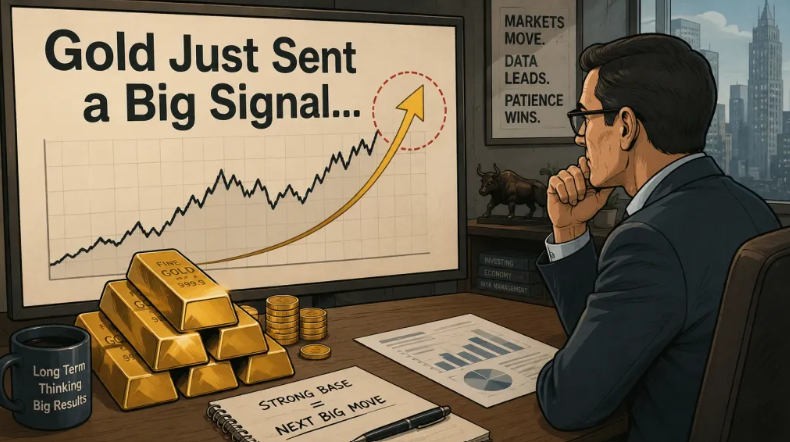
A long-term evaluation of global macroeconomic trends shows a clear structural correlation between global money supply expansion and gold prices. Historical tracking demonstrates that over extended periods, gold prices track growth in global money supply, sometimes leading the movement and at other times lagging behind it.

Over the last several years, gold prices had outpaced global money supply growth. However, over the past six months, global money supply growth has accelerated faster than gold prices, creating a gap that historical patterns suggest will eventually be bridged over time.