
Prices Can Be Misleading
We are often trained to think that when the price of something goes up, its value must also be going up. But this can be very misleading. A house may cost many more dollars today than it did decades ago, but that does not always mean the house has become more valuable. To understand the real change in value, we need to compare prices with something that has held its value over a long period.
The Gold Comparison
Consider the US housing market. In 1963, a typical new house cost around 509 ounces of gold. Today, the same amount of gold would be enough to buy almost six similar houses, based on the median new house price. In other words, the amount of gold needed to buy a house has fallen sharply over the years. Measured in gold, the price of a house has actually fallen by around 82%, even though its dollar price has gone up.

What Really Changed?
This shows why looking only at currency prices can give us the wrong picture. We may feel that housing has become extremely expensive because the number printed on the price tag is much higher. But another way to look at it is that the purchasing power of the currency has fallen. The same idea can apply to other currencies as well. The rise in the price of a house does not always mean that the house itself has gained the same amount of value.
Gold Holds Its Value
The data also shows some big changes over different periods. In 1963, it took more than 600 ounces of gold to buy a house at certain points. Around 1980, when gold prices rose sharply, the figure came down to about 100 ounces per house. Later, it moved back toward 670 ounces before falling again. Over such a long period, gold has shown an ability to retain purchasing power.
Look Beyond Currency
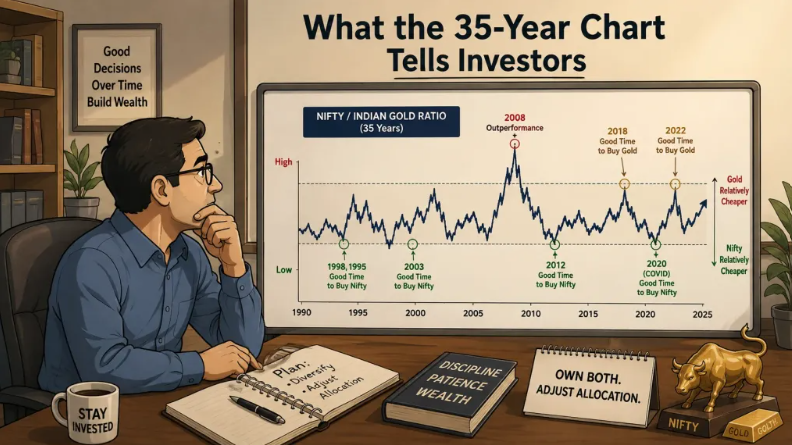
The same comparison can be made with other assets. Houses and even stocks can lose value when measured against gold over certain long periods. This does not mean these assets are useless or will always fall against gold. The bigger lesson is that gold can act as a long-term store of value. So, instead of looking only at how many rupees or dollars an asset costs, it is useful to ask what that asset is worth when measured against a hard asset such as gold.
Think in Real Value
When we say that a house has become worth many crores, we should also ask what those rupees can actually buy today compared with the past. Nominal prices do not tell the whole story. Looking at purchasing power and comparing assets with gold can give us a very different picture of how their real value has changed over time. This simple change in the way we look at prices can help us understand wealth and inflation much better.